Tag Archives: Endurance

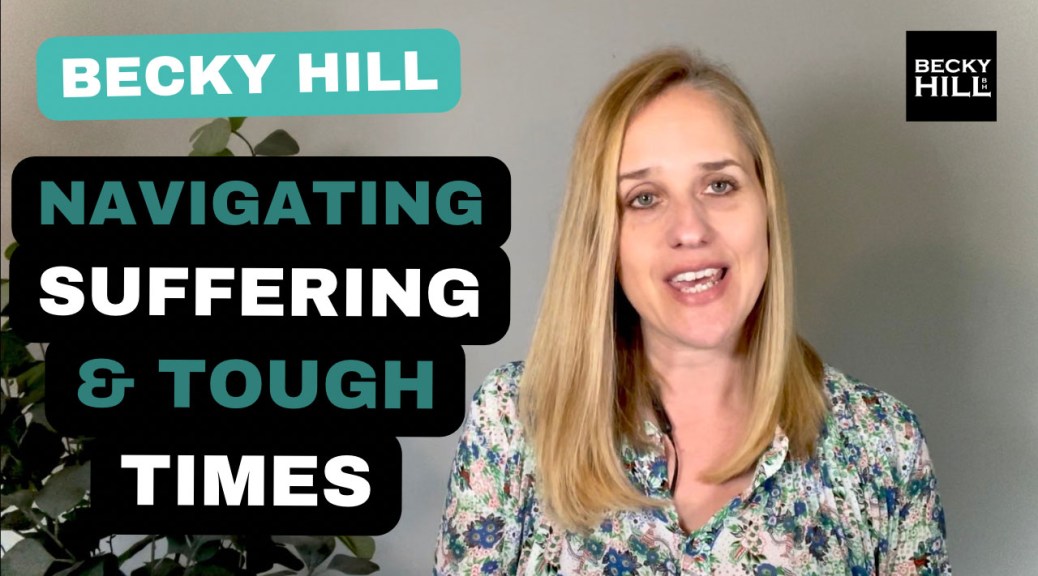
NAVIGATING SUFFERING AND TOUGH TIMES

Hello again! It’s been a while since I have shared a blog post … and in fact today I am sharing a very long one!!!!

Recently I spoke in church on Navigating Tough Times and as I was preparing it, I remembered that I had always wanted to make a video and write a post on some thoughts about how we can navigate suffering. So, I decided that I would combine my research and preparation to also write this article and put a video on my channel which includes my teaching from church – with a few minor edits.

I hope and pray that my own study, research and learning over the past 11 ½ years may well help to equip someone else in the midst of suffering. Suffering always feels horrible, it can be traumatic, life changing and full of grief and pain. But… although that is true…. It’s not the WHOLE story…

There can also be immense beauty, joy and even a deeper love to be experienced too… if we can hold on and slowly allow our perspective to be shifted.

That is my experience.

That is my reality.

And my hope today is that you too might discover some treasures in the darkness – despite your pain!

With much love and empathy to you all,

Becky x

Please note: This teaching has been prepared for a distinctly Christian audience. But I hope that those of different, or no faith backgrounds, will be able to glean something from it too.

NAVIGATING SUFFERING AND TOUGH TIMES

Isaiah 43:2: “When you pass through the waters, I will be with you; and when you pass through the rivers, they will not sweep over you.”

The real work, the hardest work, is to pick up the pieces and decide how to put them back together again. The new thing that emerges may not work the way it used to, but it can bend and stretch and change us in ways we come to treasure even more.” Katherine and Jay Wolf

Navigating Tough Times is such a big subject, as all the ‘Strong Foundations’ subjects are. Basically, this is a teaching about when things are tough and there are no quick fixes. It’s a teaching that is here to equip you to face and endure the hard seasons in life that sometimes come and don’t let up easily – whether you are in one now, have been through one in the past that still affects you or will go through one in the future.

But in talking about ‘tough times’ I feel like I need to give a disclaimer – that this is just a snapshot of understanding suffering and hard times and how we are best to deal with them as believers and as the Church. There are so many different types of suffering and struggle. Be it grief and bereavement, physical health and mental health issues, abuse, difficult job situations, redundancy, war and famine, persecution poverty, addiction, relational breakdown, loneliness, rejection, bullying, financial hardship and debt, infertility and challenging family dynamics. This has not an exhaustive list of course, it’s just a few things that came to my mind.

I never want to minimise anyone’s experiences of suffering or rate mine or others experiences above others.

But as with all the strong foundation preachers that we have heard over the past couple of months, this message is about trying to equip you to grow in your faith and go deeper in your foundations. We wanted to cover tough times and suffering because it can really make or break someone’s faith. Especially when those seasons last a very long time.

I feel very privileged to be speaking on the subject because I feel like it’s been a massive area of personal study, for me over the past 11 years. Even just looking through my phone notes, I came across so many great quotes from various books I’ve read over the years – so there will be many quotes in this message. Which I actually think is important because we need to hear different perspectives on suffering, because everybody’s experiences unique.

Tell you some of my story. I did tell some of it in one of my messages from last year: ‘Boasting About My Weaknesses.’ https://youtu.be/6PjU8i5AtMQ I also explained that this is why I pre-record my church messages as it’s easier for my body and brain and allows me more focus.

Most of you know something of my story – it is so long and complex I can only touch on my conditions but do have a public YouTube channel and blog if you were interested in more in depth of info and how I have navigated it over the years. Basically11 1/2 years ago I fell off a ladder and sustained two quite rare and very complex brain and spine injuries. I still have what is called ‘A Spinal CSF Leak’ in my spine which is where your spinal fluid leaks out of a hole in the protective layer that holds in your spinal fluid in your spine. This means your brain and whole nervous system can lack enough spinal fluid to function properly. It causes so much pain, a constant drunk/ foggy head, lack of mental clarity, a constant stiff neck, fatigue and many other symptoms. I also have Arachnoiditis which is midly adhesive. This is where your spinal nerves inflame and begin to stick to the edges of your spinal canal leaving very high levels of nerve dysfunction, pain, struggles to sit and stay in one position, travel and when in an inflammatory relapse – to walk, talk and think with clarity – without hospital visits and very high doses of steriods. Basically, they are both extremely painful and debilitating conditions I live with every day – even though most of the time ‘I look well’ from the outside.

My lack of healing and the trauma of facing countless doctors over the years who didn’t really understand due to my conditions being so rare and not well enough researched etc, also led to me having two very serious physical & mental breakdowns which left me despairing of life itself. So I have also experienced two or three serious mental health crisis’. Partly due to the immense strain of these conditions and major battles to get diagnosed and helped. But also due to trying to‘stay strong’ and striving hard to find enough faith to receive my healing. Including at the end of my first year of serious illness attempting to try to live like I was well when I was actually seriously unwell. So I ended up at the complete end of myself – not sleeping, stuck in bed in constant severe pain – in an extremely dark place of despair. And yet I still knew only God and my Christian faith could help me find a way forward whether I was healed or not. This is why – as I shared in my message ‘Boast about my weaknesses’ last year – I ultimately I had to ‘let it go’. Healing had became an idol and I had to rediscover Jesus for who he was in totally and not just ‘the healer’ & find the spiritual strength to help me endure for the long haul.

At the worst times of experiencing the deep trauma of utter darkness and despair – I found that I certainly didn’t need ‘theological answers’ – I simply needed love, gentleness, ccompassion, comfort, understanding and care. And even though God felt so distant at times and I felt like such a failure. LOVE did break through and began to bring some light in an extremely dark place. I couldn’t fathom theological thinking – It was only true, warm and gentle sacrificial love that was the thing that showed me God was truly real. I couldn’t feel God’s presence – but I could feel the fierce yet gentle love and support of my husband. Matt you showed me Jesus when I was struggling to see and feel Him directly.

REMEMBER – We can show up and reveal Jesus to those who suffer deeply – IF we are present and show gentleness, compassion, care, grace and love without judgement.

What I discovered over the next few years, was that I needed to deepen and widen my theology of suffering. Especially to help myself and others to navigate seasons of suffering that just won’t go away whatever we do. So I had to learn to listen and consider all sorts of different voices, perspectives and thinking on what the Bible says about suffering and how to approach it

One of the initial books I read which helped to open my mind was – Where is God when it hurts by Philip Yancey (I know Yancey has recently discredited himself for moral failure – but the book was written long before this and still has so much to teach us). It starts off by talking about a young couple he knew – newly married, loved God and ready to serve him. But very early in their marriage she developed Hodgkin’s disease which is a cancer of the lymph glands. She had to stay in hospital for rounds of chemo which made her so sick that she couldn’t eat, she completely lost her radiance & outward beauty. Periodically she had radiation treatment that in those days required you to lie on a metal table completely naked. Over the weeks and months, she became a shell of herself. During this time, she contemplated God and suffering.

The interesting thing that Yancey does is to record her reports of some of the well-meaning ‘Visitors’ who came and gave their advice – from all theological perspectives:

– Firstly those who just tried to ‘avoid’ the issue of her suffering and simply bring ‘positivity’ and ignore the harsh reality of what she was facing

– those who told her she had obviously done something wrong and needed to search her life for what God wanted her to change.

– others suggested God is so impressed with you that he has chosen you to suffer and he will reward you for your endurance.

– another told her – this will only end when you have genuinely learnt to praise God for the privilege of suffering.

– yet another – who loved watching the US TV healing evangelists told her – if you just have enough faith you will be healed, so rebuke the devil, increase your faith and claim your victory!!

Philip Yancey then visited her and found her not only immensely unwell and in deep despair but also utterly confused about God and what He wanted of her. Who she should listen to? What lessons she should be learning through it? How can she keep staying positive and full of praise? And how is she supposed to ‘muster up’ enough faith for this promised healing? He thought to himself upon leaving ‘Is Christianity supposed to make a sufferer feel even worse?

Why do we often choose people’s weakest times to ‘burden’ them with all of our opinions on what they need to do to improve their situation?

Now there are of course elements of Biblical truth that have influenced ALL of those opinions, advice and teachings. It’s not ALL wrong ‘in theory’. But it did remind me of the book of of Job in the Bible and his friends opinions about his suffering.

Of course, there are lessons to be learnt in suffering, God certainly allows suffering in certain seasons, sometimes our choices and mistakes can add to our suffering, we can of course benefit from praising God and being thankful despite our pain, it is also true that our faith can play a part in our healing as we see in the gospels. But as Philip Yancey touches on – we need to learn the correct time and place for opinions, advice & simplistic theology. These things are never as simple as they look and when someone is in the depths of suffering, they often simply lack the ability and energy to work through all the different theological viewpoints and all of the nuanced questions and answers. They can then despair even more when the simplistic answers and fixes don’t seem to work. I only had capacity to consider and meditate upon all these things – when my mind was less chaotic and I started feeling slightly more well again. (Although I never actually feel well – just ‘less ill’ than my worst times.)

CAN GOD ACTUALLY BE TRUSTED IN THE MIDST OF SUFFERING?

Psalm 34:18: (NIV) “The Lord is close to the broken hearted and saves those who are crushed in spirit.”

Psalm 22:23-24 (NLT)Praise the LORD, all you who fear him! 
For he has not ignored or belittled the suffering of the needy.
 He has not turned his back on them,
 but has listened to their cries for help.


Psalm 147:3 (NKJV)He heals the broken hearted. And binds up their wounds.

“You see, the message of the Bible is that the arms of God’s power, presence and grace wrap around the deepest and darkest moments of human suffering.” Paul David Tripp

Does this sound like a distant God who doesn’t care? No that is not who our God is: He is compassionate, empathetic, comforting, loving and understanding. He is not there to condemn and accuse. However, there can also be purpose in pain, redemption in suffering, the beauty of his presence, power and comfort in our deepest weakness and things we can and do learn through seasons of pain. 

SUFFERING IS INEVITABLE.

The Bible talks a lot about it. Central to our faith is the concept of a suffering saviour. The New Testament Is then full of people being persecuted for their faith, especially Paul who we will come back to later.

John 16:33 NIV In this world you will have trouble. (Tribulations ESV) (NLT many trials and sorrows) (AMP tribulation, distress & suffering) But take heart! I have overcome the world.

JESUS THE SUFFERING SAVIOUR

John Stott whilst reflecting on suffering and the cross wrote: ‘I could never myself believe in God if it were not for the cross… in the real world of pain, how could one worship a God who was immune to it?’

Philippians 2:6-8 NIV “Who, being in very nature God, did not consider equality with God something to be used to his own advantage; rather, he made himself nothing by taking the very nature of a servant, being made in human likeness. And being found in appearance as a man, he humbled himself by becoming obedient to death— even death on a cross!”

God doesn’t distance himself from human suffering, he sent Jesus to experience it first-hand. Our God is a God who through Jesus becoming human has personal experience of human suffering, physically, relationally, mentally, emotionally. He ‘laid aside his glory and majesty’ to become a vulnerable human who faced betrayal, rejection, misunderstanding and the limitations of a physical body which was brutally beaten and completely broken until he died. God didn’t protect him from pain and suffering – he led him to it. He deserved a throne but submitted to a cross.

Sometimes we may feel God is absent in our suffering. But so did Jesus as he lay brutally beaten, struggling to breathe and hold onto life on a Cross he shouted my God my God why have you forsaken me? – he too felt the Fathers distance.

Elisabeth Elliot (whose young husband was killed by tribesmen they were ministering to as missionaries in Ecuador) Our vision is so limited we can hardly imagine a love that does not show itself in protection from suffering. The love of God is of a different nature altogether. It does not hate tragedy. It never denies reality. It stands in the very teeth of suffering. The love of God did not protect His own Son. The cross was the proof of His love – that He gave that Son, that He let Him go to Calvary’s cross, though “legions of angels” might have rescued Him. He will not necessarily protect us from anything it takes to make us like His Son. A lot of hammering and chiselling and purifying by fire will have to go into the process.

SUFFERING AND THE SECULAR WORLD

“Suffering causes us to scan our lives and face the fact that we control very little. Paul David Tripp

Suffering in its simplest form comes in the space between what we thought would be and what is. – Katherine & Jay Wolf

One of the best books I have read on suffering is Tim Keller ‘Walking with God through Pain and Suffering’The book deals with theology, philosophy, psychology, Christian apologetics (defending the gospel) – but also interweaves many deeply moving personal and diverse stories of deep suffering and pain experienced by Christians from all sorts of human experiences of suffering – I highly recommend it!

In the early chapters of the book, he writes a lot about the diverse and different perspectives on Suffering from around the world and from different religious and spiritual perspectives. He also spends a quite a bit of time explaining how secularism in the West has caused a major cultural shift over the past century or so regarding views on suffering and how well we deal with it.

He writes about how the secular assumption that life is just confined to this material world and lifetime means that people live their lives for what feels ‘good to them’ in this world so: comfort, safety and pleasure are of the upmost importance.’ Suffering is then a BIG problem to this because it blocks you from achieving these things as you might want.

So the underlying message of our society is: AVOID SUFFERING AND PAIN AT ALL COSTS!

Interestingly, Keller references Dr Paul Brand’s book The Gift Of Pain’(Philip Yancey does too in ‘Where is God When It Hurts?. Doctor Brand worked with leprosy patients whose bodies were ravaged because they lacked normal pain sensation’s so he argues that pain can actually be a gift to us that warns when something is wrong in our bodies, without that you injure yourself without knowing etc) Dr Brand also writes about the difference in how people viewed and dealt with suffering in India – where he worked with leprosy patients – compared to the USA. He observed in the West that mmeaning in life is often caught up in the pursuit of pleasure & personal freedom & achievement – he suggests that ‘this is why suffering is especially traumatic to Americans. Many other cultures in the world put higher meaning on something other than individual happiness & comfort. This can be be moral virtue, gaining your way into paradise by good works, aiming for enlightenment after being stuck in karmic cycles, honour of those around you, faithfulness to the truth, putting family virtue higher than individualism or pursuing a greater meaning spiritually or philosophically. So in these cases suffering can actually been seen from the perspective of helping you to achieve those things:

Where as in the Secular world suffering rarely has much meaning or purpose: those who suffer feel that they are ‘a victim’ of something that is simply – a big distraction, an unwelcome tangent and a chaotic interruption to our comfortable, safe lives. So it should be prevented, stopped & alleviated wherever possible!

Whereas even in Western history suffering was simply part of a normal life story. For instance, in the 1800’s 40-50% of children died before their 5th birthday and the average life expectancy globally was only 30-40 years old. Suffering and death of your closest loved ones was a normal part of people’s daily lives far more than now. But people had to choose resilience and endurance, to learn & grow through their experiences. Whereas sometimes in modern times we can lack resilience and perspective.

The influence of the secular/ material world around us, can thus actually damage our view of God and can lead to a sense of ‘spiritual entitlement’ as Tim Keller calls it. The belief that God owes us a comfortable and pain-free life and should ensure all of our plans for our lives go as smoothly as possible.’ We then (and I can say this affected me on my journey) struggle when things suddenly get so hard – and pain, discomfort and shifting life plans become our norm. BUT this is where I had to learn to enter back into a proper view of the gospel and the message of Jesus’ life and the cross.

In reality, being a disciple or apprentice of Jesus means ‘taking up our cross & following him’ (Matthew 16). Even though God is a loving Father who will protect and provide for us. He is not interested in giving us an easy, comfortable and pain free life. Which can then cause us to become more individualistic and self-absorbed. Following Jesus’ example of the greatest of self-sacrifice on the cross, is meant to be uncomfortable, difficult and challenging, As Jesus followers, we are to surrender our control, influence and desires to him. We are to live a life of sacrificial love towards God and others.

But this is difficult in a culture that teaches us to ‘seek out comfort and pleasure at any cost. And even more sad, is when this all creeps into our Christian world view. The ‘prosperity gospel’ was affected by this – it made, and still does make, tempting promises of achieving a life with full health, financial abundance and spiritualising the American dream – if you can just believe enough for it. But is this who Jesus was and what he represented – money, wealth and power? No Jesus lived an incredibly humble life – he grew up a quiet town, followed his dad’s profession of being a carpenter. Then once his ministry started at age 30, he was a travelling minister with no fixed place to live. Those who followed him usually gave up their livelihoods and fixed addresses to follow him. Persecution was real to both Jesus and also in the book of Acts. The apostle Paul’s list of his sufferings and persecutions in 2 Corinthians 11 puts into perspective some of our own daily struggles. Paul was whipped, beaten, stoned with rocks, imprisoned, shipwrecked, adrift at sea, lacked essentials, was frequently exhausted and felt deep concern for the churches. But interestingly he writes in Philippians 4 that he learned the ‘secret of contentment’ despite all these immensely ‘tough times’.

WHY SUFFERING?

In the Bible book of Job we are given an insight into one man’s immense suffering and his wrestles with it. We are given a window into the spiritual realm to see some of why Job is suffering – but it is never revealed to him directly. However, interestingly when he asks God for answers – God does not directly answer his questions. He simply reminds Job of His great power, wisdom, wonder and the glorious intricacies of the nature around us which as the Bible book of Romans tells us – should reveal to us who God is.

It makes the question of why there is suffering complex with little definitive or clear answers.

Of course there are truths we can glean from the bible – The influence of Satan and his forces of evil, human Sin, selfishness and the thirst for power and control that is introduced to us in the garden of Eden. And subsequently led to death entering into the world causing it to slowly become broken and fractured! The book of Romans also gives us insight into this as do other books and passages.

However, these reasons in themselves would take a whole message or series of messages to work through and try to explain. So I recommend if you are interested- doing a deep dive into what the Bible says about suffering yourself or read a book like Tim Keller’s for an overview.

So instead of trying to answer  WHY I want us to turn back to thinking about HOW CAN WE PERSONALLY AND AS A CHURCH PRACTICALLY NAVIGATE TOUGH TIMES?

WHAT CAN WE DO?

PURPOSE & MEANING IN PAIN

Romans 5:3-5: “…We also glory in our sufferings, because we know that suffering produces perseverance; perseverance, character; and character, hope.”

Any great calamity in the natural world – death, disease, bereavement – will awaken a man like nothing else could and he is never the same. We would never know the treasures of darkness, if we are always in the place of placid security.” – Oswald Chambers

VIctor Frankl was a Neurologist, psychiatrist & philosopher who wrote a book called Man’s Search For Meaning’ after spending time in a Nazi concentration camp for being Jewish. His personal experiences and observations of other prisoners showed him that those who found a deeper meaning and purpose in their suffering were generally those more likely to survive. In the book he quoted another philosopher to support this point who put it: “He who has a why to live for can bear with almost any how.” After the war went on to develop ‘this theory’ in his psychological work.

I have discovered our faith in Jesus and the truth of His gospel (which is so different to our secular world) can become our MEANING and PURPOSE. It is the gospel of Jesus Christ and His upside down kingdom, that gave me the strength, purpose and inspiration to keep on going even with all of the unknowns that continue to hang over me. Loving God and serving Him – despite our grief, pain and trauma – can be our anchor. Loving others and allowing our own pain to soften us and connect us more deeply to others can make all sorts of suffering strangely beautiful.

This is one of the greatest ‘treasures’ in the darkness.

James 1:2-4 NIV “Consider it pure joy, my brothers and sisters, whenever you face trials of many kinds, because you know that the testing of your faith produces perseverance. Let perseverance finish its work so that you may be mature and complete, not lacking anything.”

So we see that we CAN praise God and even discover HIS joy in our tough times because it is not wasted time (as the secular view) or a tangent. GOD WILL USE IT. He will strengthen us, help us to grow and mature, build resilience – all whilst learning more humility and love for others (if we let him do it!) I have also found that our love for others can also become more purposeful because it takes more sacrifice to love when you are hurting, tired and in pain. But self-  sacrifice is always at the heart of true love.

Romans 8:28 And we know that in all things God works for the good of those who love him, who have been called according to his purpose.

“The Bible talks of suffering and difficulty as a furnace in which many impurities of soul are “burned off” and we come to greater self-knowledge, humility, durability, faith, and love.” – Tim Keller

LAMENT

This is the scripture Jesus quoted on the cross to reflect his own despair. Even Jesus lamented.

 Psalm 22:1 My God, my God, why have you forsaken me? Why are you so far from saving me, so far from my cries of anguish?

‘Lament is an expression of deep grief, anguish, sorrow or regret (often outward and vocal – although in Romans 8 the bible refers to this sometimes being without words and a ‘deep groaning within us)

We particularly see a lot of lament in Bible books like Psalms and Lamentations

Lament is simply the deep acknowledgement and processing of things being not how they should. The Psalms are songs and poems full of this. Through these scriptures God is giving a voice and words to human suffering and showing us that it is ok to struggle, to grieve, to be angry and frustrated at how life is. Lament should be expressed in prayer and in the midst of community. As a church we should allow people to lament without trying to get them to move past it quickly.

Lament can actually help us to wrestle through to a deeper, rawer and more real and tested faith. If it is given room to do it’s work. This is what the Psalms show us that start with very raw lament, but then often end in praise.

Even Jesus wept at Lazarus’ tomb – even though he was just about to raise him from the dead.

LEARN FROM OTHER CREDIBLE CHRISTIAN LEADERS & MINISTRIES WHO HAVE FACED SIMILAR TYPES OF SUFFERING – seek out their stories & teaching. Our stories are all unique but sometimes we need to hear voices that can relate to our own stories of suffering.

This was invaluable to me. I didn’t have leaders who had experienced what I had. So although they could support and comfort me – they couldn’t always understand and equip me like others who really had gone through similar challenges.

Here are some general resources:

BIBLE DEVOTIONS/ STUDIES

  • You Version Bible App A free app with devotionals / Bible reading plans about your personal challenges. Search for plans on topics such as: Suffering, grief, anger, anxiety, addiction, forgiveness, abuse etc

THEOLOGY & APOLOGETICS (WITH REAL LIFE STORIES)

  • Walking with God Through Pain & Suffering – Tim Keller. (Tim Keller died in 2023 of pancreatic cancer also his wife had long term severe Crohn’s disease. The book also includes many other diverse stories of suffering including bereavement & grief, divorce, infidelity, infertility etc)
  • Where is God in all the Suffering – Amy Orr Ewing (also on the Lead Podcast)

WRESTLING WITH GOD THROUGH HARD TIMES

  • God on Mute – Pete Grieg (When God seems to stay silent in difficult times)
  • Hope heals/ Suffer strong/ ‘The Good Hard Story Podcast – Katherine & Jay Wolf’ (Also watch their videos on YouTube) Katherine & Jay Wolf ‘Suffer Strong’ (Katherine had a brain stem stroke at age 26 – 6 months after the birth of their son. After life saving surgery and 2 years of rehab she is mainly wheelchair bound with many disabilities but seeks to speak up, help and advocate for those weak, hurting and disabled – especially Christians.

SUFFERING FOR THE GOSPEL

  • The Hiding Place – Corrie Ten Boom, Rescued Jews from the Nazi’s in Holland then ended up in a concentration camp.
  • Tortured For Christ – Richard Wurmbrand. A Romanian Pastor who was tortured and imprisoned for his faith by the Communists
  • Persecuted Church resources – Release International, Open doors (website, videos and podcasts) remind us of those who currently ‘suffer for the gospel’ and need our comfort and support which can also help develop a better perspective on our own struggles. (These books and resources really helped/ help my own perspective of my suffering.)

GET SUPPORT – other believers, Pastoral Care Team, Life Groups, Men’s and Women’s ministries, Arise Youth Team. Sometimes outside support is also needed such as medical support, a specific therapy or counselling or a particular agency that deals with your particular challenges. (We are developing a Pastoral Care Directory to help direct people to places we are already aware of.)

HOW CAN WE SUPPORT OTHERS SUFFERING?

 Think too of all who suffer as if you shared their pain. Hebrews 13:3 J.B. Phillips New Testament

Our compassion and empathy can actually really deepen when we have walked the humble path of long term suffering and have faced the depths of our own weakness. It is one of the great purposes and privileges of pain. Sharing in the suffering of others and carrying one another’s burdens without judgement.

LISTEN

ACKNOWLEGE

PRAY – IF WELCOMED

OFFER COMFORT

“Suffering invites us to be radically human with one another, perhaps doing nothing more than reaching across the table, clasping hands, and weeping together. We are afforded the chance to create a safe place for someone else to mourn…” Jen Hatmaker

LISTEN – Stephen R. Covey states“Most people do not listen with the intent to understand; they listen with the intent to reply.” 

The Bible book of Job & his friends are again a good illustration. At first they chose the best path of silence – simply being with their friend as he suffered greatly. However. The problems then began when they opened their mouths to offer Job all their ‘opinions’ on why he was suffering.

Please remember that we don’t always have to ‘find the right words to say’ and that’s ok – you can offer your presence, a kind look, even a genuine tear, a hug, a gift, a meal.

ACKNOWLEDGMENT (of pain) is everything to someone struggling!

Rather than trying to ‘fix’ someone’s pain with advice – we firstly just need to ‘acknowledge’ it. Ie. ‘I am so sorry you are hurting – it must be very hard’… then mostly try to listen.

PRAY FOR OTHERS – But always ask for permission and enquire about what they specifically want prayer for. ie. Sometimes people who have long term illness and disability can find others assume that is what they want prayer for or even force it. However, sometimes they might be trying to get the focus off that thing and onto Jesus as a whole. So where possible – be gentle, understanding and listen before you pray.

BRING COMFORT

2 Corinthians 1:3-4: “Praise be to the God and Father of our Lord Jesus Christ, the Father of compassion and the God of all comfort, who comforts us in all our troubles, so that we can comfort those in any trouble with the comfort we ourselves receive from God.”

Comfort others with the comfort you receive. This is one of the purposes and benefits of suffering if we allow it to deepen our empathy, understanding (rather than our anger and bitterness) It enables us to  comfort, support and communicate with more understanding.  But be careful not to compare your situations – all our stories are unique so tread carefully in the language you use.

THERE IS ALWAYS HOPE

Revelation 21:4: “‘He will wipe every tear from their eyes. There will be no more death or mourning or crying or pain, for the old order of things has passed away.'”

As believers when we die, we are heading to a gloriously perfect place where our bodies will no longer be sick or feel pain or saddness. Ultimately, the bible book of Revelation tells us that there will be a New Heaven and New Earth. Can you begin to imagine this world joined with Heaven and God’s presence and love and completely perfected! I always hope then I will be able to see some of the world’s wonders made perfect again – because at the moment it is so tortuous to travel very far and I love seeing beautiful places.

CONCLUSION

Isaiah 41:10 NLT “Don’t be afraid, for I am with you. Don’t be discouraged, for I am your God. I will strengthen you and help you. I will hold you up with my victorious right hand.

Navigating tough times and suffering is hard. Our stories and journeys are unique. Katherine wolf I spoke about earlier has a podcast called ‘THE GOOD HARD STORY PODCAST’ with a strapline ‘because the good story and the hard story can be the exact same story.’ And I relate to that so much. Suffering is awful, it always feels horrible. It can come like a sudden tornado and send your life spiralling and crashing down around you. But I am here to remind you our suffering saviour SEE’s you and He loves you. If you can reach out to Him he will wrap his perfect arms around you and hold you until you feel a bit stronger. He will send people to help, support and comfort you – if you keep that door open and don’t isolate or withdraw. And ultimately, he will use even the worst, most tragic and traumatic things that can happen in this world – for His glory and to build into your life a testimony of His goodness and grace.

And then your own story of pain might then become a treasure and anchor in the darkness for someone else stuck in the dark fog of grief or despair!

Isaiah 61:3: He can “bestow on you a crown of beauty
    instead of ashes,
the oil of joy
    instead of mourning,
and a garment of praise
    instead of a spirit of despair.
Then you will be called oaks of righteousness,
    a planting of the Lord
    for the display of his splendour.”

To finish with:

This poem is based on text found scrawled on a cellar wall in Cologne, Germany, in 1943. It is believed to have been written by a child hiding from the Nazis:

I believe in the sun

Even when it is not shining

And I believe in love

Even when there’s no one there

And I believe in God

Even when He is silent

I believe through any trial

There is always a way.

But sometimes in this suffering

And hopeless despair

My heart cries for shelter

To know someone’s there

But a voice rises within me saying “Hold on my child”

I’ll give you hope

I’ll give you strength

Just stay a little while.

Learning Patience: Eighteen Months of Spinal CSF Leak Improvement

UPDATE: Please note that in August 2020 I was also diagnosed with arachnoiditis as well as a spinal CSF Leak – I now have radiological evidence to support both those diagnosis. To read more about the new diagnosis please see this link.

“What doesn’t destroy me makes me stronger.”

 – Martin Luther King, Jr.

This timeless quote has certainly been my experience over the past four years or so of having – and then recovering from – a long term spinal CSF leak. Although, to be honest, at times it did feel like I was being ‘destroyed’ through the process. My journey has taken me to immensely dark places of wrestling and torment on so many levels.

It often felt like so much of who I was – at the deepest level – was simply being destroyed.

However, as I slowly recover physically, mentally and spiritually from the trauma of the last four years, I can see more and more how even what felt like ‘destruction’ has actually ultimately made me a more rounded, secure, loving and compassionate person. I have found that some things, and attitudes in my life, needed to be ‘destroyed’ or at least ‘shaken’, so that I could become the person I am now.

I am stronger on so many levels – but the strength comes from a more authentic place.

The strength comes from a deeper acceptance and acknowledgement of my human frailty and weakness. I no longer feel the need to have to ‘muster up’ an outward – or even ‘inner’ – show of strength to look like I ‘have it all together’. Instead, I can rest in my weakness and rely on God’s strength to carry me through the ongoing challenges of life in a more REAL way.

And there are ongoing challenges…

Eighteen months since my fourth high volume (40ml) lumbar epidural blood patch seemingly sealed my leak, I am still not back to where I was before my accident in January 2015.

My head, spine and nervous system still do not operate as they once did.

And yet…

Month by month I see more of the new ‘old me’ being restored.

Slowly… gently… patiently… Becky Hill is returning to a ‘fuller and deeper strength’.

But did you notice that I said the ‘NEW ‘old me’?

I had to add in that extra ‘new’ …. because the ‘old me’ doesn’t actually exist anymore in many ways!! And in fact I wouldn’t want to return fully to who I was before my accident anyway. Because there is a ‘new me’ that has emerged from the ‘wilderness cocoon’ I was catapulted into for those years. It is the ‘new me’ that will walk into the future and face whatever comes my way.

It is the ‘new me’ that is better in many ways than the ‘old’

However, the reason I am writing this article is to get into the nitty gritty of my experience of spinal CSF leak recovery. I want to continue to tell my story in the hope that it connects with and helps you, or someone you know, on their own seemingly impossible journey. I want to tell you the REAL tale of what it’s like to walk along such a difficult and desolate road, whilst attempting to keep focusing on the beautiful horizon of hope and redemption.

A new horizon that thankfully, for me, is growing ever closer.

So let’s get back to basics.

What is my life currently like day-to-day, eighteen months into recovery from a nearly three-year spinal fluid leak?

Corrie ten Boom said:

‘Worry does not empty tomorrow of sorrow; but it empties today of strength.’

That has had to be my ongoing ‘mantra’ throughout my illness and recovery. At first, fears for the future and fears of relapse consumed and crippled me. Unsurprisingly, of course, because – until this last blood patch – that had been my very real experience. These fears have reduced so much through a combination of learning to stay focused and thankful on the present, whilst accepting what IS today’s reality, and also seeing the progress that I continued to make day by day. I had to ‘throw myself’ into God’s arms of grace to find the strength to keep moving forward and keep trusting that things would keep improving.

As they currently do!

If you try and fight the slow process of recovery to ‘speed things up’, I found it simply makes you worse! Your body can’t handle the stress of the striving to do more than it can do. You instead have to ‘fight’ from an inner place of strength, peace and acceptance of the way things currently are, whilst being gentle with your body and mind as you trust for better days in the future.

The reality is, my head, spine and nervous system still struggles with hypersensitive reactions to changes in ICP (Intracranial (head/ spinal fluid) pressure). I still seem to have some ‘pressure’ issues in my head and spine (as I talk comprehensively about in my year of recovery update). The same old movements and actions still bring a clear reaction. My head, neck and spine fills with pressure, my ears pop and crackle, my cognition (mental processing) gets a little more sluggish, everything feels harder, and I often have to just take some ‘quiet time’ alone to still my head.

This might mean being silent for a bit, sitting down quietly or going for a quiet walk.

But I have to say that this becomes more and more manageable and less and less of a major problem. The adjustments needed are not so dramatic anymore. They are still there, but more subtle. And they thankfully keep improving. Over time you realise you are less aware of symptoms – they are still there but less and less prominent. They seem to impact things that little bit less week by week, month by month.

That’s when you feel like you are recovering more of the ‘old healthier’ you.

Blog learning patience_edited-1

Here are some of my personal ongoing symptoms and the way that I approach managing them. They may not be the same for others, but I share this to help educate other sufferers, their family and friends, and any medical professionals that may be reading this blog. This way, we can all show more understanding and compassion to one another and ourselves.

  • My head can still get very overwhelmed with a lot of things happening at once. It’s the ‘layering’ of things, one on top of another, that causes the biggest issue. Noise especially. My family and I are all natural singers so we love to have music on, and their default can be to sing along (singing can still be more of a challenge for my head). But I really struggle with both the music and others singing simultaneously – especially if there are other noises around too. It becomes a ‘mental overload’ for me, as does trying to think, listen, talk and cook at the same time. I often just can’t ‘compute’ it all as well as I used to. But this is also all improving over time.
  • Multi-tasking is slowly getting a little easier but is still a lot harder than it was before the accident. It’s again a ‘layering’ issue.
  • I can’t rush about, which although frustrating has actually taught me to ‘flow’ through life more calmly, and to be even more organised. I have to keep moving around gently without rushing about. My head and spine can’t take the twists and turns that rushing often brings. Also, moving around and talking a lot at the same time is still very hard. I can focus better if I stay still whilst talking.
  • Speaking for a long time can be hard still, especially if my head is already feeling more hypersensitive, or if I’m walking or moving about at the same time. I can talk for noticeably longer than I used to be able to though, which helps me with relationships in general, as well as with the mentoring and pastoral visits and teaching groups I do with church. I do find once I have talked for a while I often need some ‘quiet time’. My family know to let me be quiet, and I often put my headphones in and go for a walk, or focus on being quiet to still my head.
  • I still spend quite a lot of time being quiet at home doing the housework I can do, looking after my family and cooking. We love having people around for food, or to stay, so we are really enjoying re-discovering this joy of ours. I just have to plan everything well in advance to avoid any last minute stresses. I also love to cook for others who are struggling for any number of reasons (as people did for us when I was at my worst) so I often take food with me on visits to suffering people. I have been able to increase my ‘pastoral visits’ and the church admin that I do from home. I also continue to teach and speak in smaller groups and do a lot of ‘one-to-one’ personal development work with people. I am so very thankful to be able to take on what I can, when I can through our church, and this it fits in with our home life and me keeping on top of that.
  • Bending, lifting and turning my spine and neck still makes my head worse. I usually get a burst of pressure into my head that can take a little while of being calm and quiet to clear. Generally, the straighter I keep my spine the better. However, it does mean that I remain very careful with movement and what I carry. We still have a cleaner (who we employed when I was leaking) who comes for a couple of hours every two weeks to do hoovering, mopping and bathrooms, since this would involve at a lot of bending or lifting for me, and I avoid it where possible.
  • I am still very careful to always go on my knees or crouch instead of bending my back to get things from low down. This action is better for my head and also protects my spine (although it’s not as good for my poor knees. However, the garden kneeler I bought does help a bit with that in the kitchen and outside!!). But I’ve found that it’s just not worth pushing my spine and head. It’s too uncomfortable (sends pressure into my head) AND too much risk for me to see how much I can ‘push’ things safely. There are too many unknowns to take the risk, too many memories of multiple relapses. And treatment and recovery takes such a long time, if I was to relapse again. So I keep movement and general rehabilitation gentle and safe. I want to give my spine the best chance of full and lasting healing.
  • I can carry much heavier things than I used to (with clear self-imposed limits) but I avoid lifting them from low down and I always – by default – tend to carry things against my chest with both arms i.e. one ‘heavier’ shopping bag at a time. This seems to put less strain on my spine and so is better for my head and I guess protects my spine more too.
  • Bending my head to look down (i.e. to read, write or use my phone) is still uncomfortable and can send more of a ‘pressure rush’ into my head. But again, this is improving, and I am aware of it less than I used to be.
  • Sitting down for a while in one position can leave my spine and head full and my body very stiff, possibly linked to my spinal nerves and the pressure changes throughout my spine. So I still have to regularly get up and have a walk about.
  • If I sit down I am still better sitting on a harder surface with a very straight spine. Sitting on the sofa is especially bad for my head. If I’m watching a film or something of length, after about 30-45 mins my head can often feel fuller and cause me to yawn. I can feel very sleepy and my ears start to pop. I often have to get up and move around slowly to ease it a little. I can’t relax back on the sofa or lie down on it either – it’s too uncomfortable for my spine and head.
  • Going to the loo can still affect my head, I have to be very careful not to strain in any way. Even normal slight straining (just going for a wee) can still affect my head, especially first thing in the morning or if I’m trying to clear my bladder last thing at night.
  • When the pressure increases in my head, the tension and pressure in my neck, spine (particularly the bottom of the spine) tangibly increases as well. I feel it as a full pressure-like pain which is uncomfortable, but not unbearable.
  • In the mornings (especially but not exclusively) the feeling of pressure increasing in relation to action or movement can still occasionally make me want to cough, sneeze or even gag. It’s a bit like the sensation of having a ‘head cold’. This is especially true if I end up talking too excitedly OR too frustratedly (normally with difficult children :-)). It can also happen when I am getting ready and using more exertion to put on clothes and things like socks (even though I rest my foot on the end of the bed to avoid bending to do it). But it will normally subside reasonably quickly with some quiet and still time. It has also improved a lot recently.
  • The weather being rainy and stormy can make the above a bit worse (probably due to atmospheric pressure changes), as can having my monthly period.
  • I still have some light and noise sensitivity. Particularly to flashing lights, fast moving images (both of which can still feel overwhelming and make me feel nauseous) and listening to heavier music with a lot of drums and beats.
  • The worst times for my head result from increased stress, rushing or a lot, or talking a lot whilst doing things. I had an occasion a couple of weeks ago when I had to get ready for a church group that meets at our house weekly. Matt was away with work and one of my daughters was being persistently ‘difficult’ and talking frustratedly at me a lot. It completely overwhelmed my head, which quickly filled with pressure, and everything just felt so difficult to do until I could hardly think straight, or concentrate on anything, and simply felt tearful. In these situations I just know that I have to be completely silent to get what I need to done, then try and be as still and silent as I can until people arrive. But sometimes convincing my kids that I cannot deal with talking to them any more when they are already frustrated is the challenge. It took a little while of being very quiet but, by the time people arrived, my head could handle a bit more and I could lead the meeting OK. (Thankfully we began by listening to a recorded group Bible meditation for 10 minutes, so I got to be quiet – which helped settle my ‘full’ head too).
  • Sometimes a lot of talking, stress or attempting to rush can build the pressure and leave me feeling a bit sick and nauseous – like the above occasion did at first.
  • My general biological ‘coping mechanisms’ are still not what they once were. My body and head still cannot physically – and subsequently mentally – cope with and manage stress very well. I was always pretty good at coping with stress and pressured environments before my leak, but now I have to very carefully manage stress and anxiety because of the natural impact it has on ICP. (As I talk more about in my year of recovery update post). As with everything else though, this is thankfully improving slowly but surely.
  • The acute headaches I got post-blood patch whilst lying in bed – especially when I woke (that I mentioned in my year update) have improved a lot in the past two to three months. So I can thankfully generally stay in bed, even if I wake in the middle of the night or early morning, rather than having to get up at crazy hours. But I still often feel uncomfortable and have a milder headache, or my head will especially feel strangely ‘full’ (sometimes it’s still a bit worse and I just have to get up). So I don’t really do ‘lie ins’ and I still NEVER lie down in the daytime. My sleep can fluctuate a bit too, although I tend to have really good times followed by more wakeful times. But that is normal for many people anyway.
  • I am now medication free! About 3 months ago I finished weaning myself fully off the last of my Nortriptyline prescribed for neurological pain. I believe taking it somewhat helped some of the higher pressure symptoms from a couple of months after the last blood patch in September 2017, but more recently I wasn’t sure it was doing much, and I was tired of the constant dry mouth. Coming off it slowly didn’t seem make any significant difference to my symptoms, apart from I no longer have to drink as much in the night or early morning, or chew gum constantly to deal with the dry mouth. Interestingly, though, when my head pressure increases, the dryness in my mouth can return too.
  • My heart finally seems to beat pretty normally again these days. This took a long while to settle from the constant mis-beats and irregularities that a previous ECG confirmed (but were considered annoying but not concerning medically) when I was leaking badly during the summer of 2017. My leak definitely seemed to affect my heart, and then the increasingly poor conditioning probably made the issues worse. Even after successful treatment, this took a long time to gradually get better. All the strange beating patterns made lying down and relaxing harder at first, as they were more prominent when lying down. And this all added to the anxious feelings at the time. So life is more restful not having this problem anymore.
  • I have had to learn to live and ‘flow’ from more of a place of ‘inner peace and rest’. I am learning a whole new, more peaceful and less chaotic and busy ‘way of life’. I have embraced the lessons learnt from this over the past years and vow to maintain a more restful balance in my life moving forward. I want to resist falling back into a more ‘busy or chaotic life’ in the future, even when I can cope with those pressures more. Living from a place of ‘spiritual peace and rest’ is the best way to live long term.
  • I still find long, gentle walking helps my body, head and mind – as well as my connection to God. So I still generally take two approx. 20-50mins walks a day, when I can. I appreciate the surrounding countryside so much more since my years of debilitation. My pace has also picked up a lot in the past year, but I still cannot rush.
  • Filling my mind with positive, calming, spiritual thoughts is so important to enable me to live from a place of increasing peace, rest and love.  I am enjoying using this new peaceful Christian meditation app to help with this (mainly whilst walking or quietly doing housework) www.soultime.com. It’s a great resource to bring more peace, rest, calmness, love and spiritual connection into my day. I also love more peaceful contemporary Christian worship music but generally have to avoid louder heavier music.

So that is a summary of some aspects of my day to day life and the ongoing challenges of recovering from such a life-changing injury.

People often ask me these days …

‘Do you think you will ever get back to feeling ‘normal’ like you did before all this?’

I have learnt to answer honestly…

‘I simply don’t know’.

Perhaps only time will tell!

But my hope and faith rests in God alone and in the fact that I do see so many ongoing improvements all the time. Yes, they are slow, often so very gradual, and sometimes frustratingly subtle in the short term. And yet, as we look back we can see the MASSIVE changes in the past year, and even in what I can do and cope with over the past six, or even the past three, months. That is the hope of continual improvement we hold onto.

When you can keep seeing change it does encourage you to never give up believing for better times ahead.

When I was obviously leaking, we would, at times, also see very slow, gradual improvements. But any improvement would ALWAYS seem to plateau in the end. I would always reach a kind of ‘lid’ that I couldn’t break through. And even if things remained a bit better for a while (especially after treatment) in the end they would always regress or I would fully relapse again weeks or months later due to clear or unclear triggers.

So, seemingly having no ‘lid’ to my ongoing improvement brings us so much encouragement for the future. 

So again I want to share my hope with you all.

It’s a clear hope for the future but mixed with realism about the journey. My journey has been made somewhat easier in that my family never relied on me bringing in an income of my own. Thankfully my husband’s salary covers our family’s living expenses. My ‘church work’ is voluntary – which has actually been beautifully freeing because I can balance it all with the general demands and pressures of family life.

Had I had to try and get back to a demanding career, or had we been reliant on me getting back to earning a wage, we know that it would have made my recovery and our family’s lives unbearably chaotic and perhaps impossible. The reality is, even now I know I couldn’t function working full or even part time in a busy and intense job or career. It’s important that people are aware of this as a potential longer term consequence of living with a spinal fluid leak followed by walking the slow and complex road to recovery.

It is not as simple as ‘being fixed’ then quickly ‘getting your life back’!!

Life may now look very different to what it did before – long term.

And yet, we are all different…

Blog learning patience quote_edited-1

Our stories and experiences will be different. Each of us has to learn to work it all through as best we can with the lives we currently live. Some people may find that they can give more time and energy to re-discovering a job or career, especially if they don’t have so much responsibility around the home and family, and if they have a very understanding employer that is aware of their limitations and their need for a quieter work environment. It’s a balancing act and will take much wisdom to find creative ways to embrace what you can do, whilst being very aware of the limitations and sometimes unknowable risks of what you can’t.

This all takes a certain level of acceptance in finding true peace about your ongoing limitations.

So my deepest prayer for all of us is this…

That we may all receive more of God’s grace and strength to find the way through the unique storms, and sometimes living nightmares, that this broken world throws at us. Your story might have some parallels with mine – or it might be completely different! However, despite the differences, ALL of our stories are powerful. So please consider who your own story might help – today, or tomorrow.

And please don’t suffer in silence!

Speak up, get the help and support you need, and then maybe you can BE help and support for someone else.

Because you never quite know what a difference your seemingly ‘boring’ tale of suffering and pain might have in the life of another desperate, struggling and often lonely soul. You never know what your REAL tale of living in and rising from the ruins of destruction might mean to someone else who currently feels so trapped and destroyed by their seemingly never-ending struggle.

As I was reminded recently in these profound words;

“Your story is the key that can unlock someone else’s prison.”


Please do comment or ask any questions below. Or alternatively you can email me at beckyhillblog@outlook.com

To read more about my story of living with and recovering from a chronic spinal CSF Leak click here.

Here is a brilliant 2 min animation about Spinal CSF leaks.

For more information about spinal CSF leaks please see the UK charity website at www.csfleak.info or the US charity website at www.spinalcsfleak.org.

Here is a medical journal publication about rebound intracranial hypertension (rebound high pressure) as a short or long term complication following epidural blood patching – as I seemingly experienced at least after my last three blood patches. 

Please see this new May 2018 medical paper about the 10 most common myths and misperceptions about spinal CSF leaks. It is by some of the top world experts in treating this condition. I was told so many of these myths by various neurologists, anaesthetists, radiologists and many other doctors during my lengthy and traumatic nearly 3 year battle with a spinal CSF leak. This kind of misinformation caused many delays, misunderstandings and great distress on my already immensely long winded and very difficult medical journey.

This other in depth 2018 medical paper is about both low and high intracranial pressure syndromes and their similar and different symptoms. It also mentions cross overs with other headache types. When a patient suffers with a spinal CSF leak long term it can cause massive fluctuations in their whole pressure system both whilst suffering from a spinal CSF leak and following treatment. This is why lumbar puncture pressure readings and ICP pressure monitoring can prove an inaccurate diagnostic tool for SIH (low pressure)  and RIH (rebound high pressure) as this paper refers to as does the 10 myths paper. My initial LP in February 2015 reading was a 7 which was considered ‘evidence’ of low pressure by some doctors and normal by others.

Finding A Way Through: My Spinal CSF Leak Improvement

UPDATE: Please note that in August 2020 I was also diagnosed with arachnoiditis as well as a spinal CSF Leak – I now have radiological evidence to support both those diagnosis. To read more about the new diagnosis please see this link.

Our greatest glory is not in never falling, but in rising every time we fall.– Confucius

It’s been a while since I have written here. The last six months have been a season of deep trial and anguish, whilst simultaneously becoming a season of great joy. My ongoing health battles have been truly exhausting and yet…

I am currently seeing some light at the end of the tunnel.

And today, I have rediscovered my voice to share my story. 

Following just about holding on through the immense challenges of the the last three years – since I fell off that ladder in January 2015 – I can now pretty confidently say that it seems that I am currently in recovery from my CSF leak. We are hoping that this timefollowing epidural blood patch number four last September – that I can make a full recovery.

At the moment it looks like we are heading that way. And yet my three year journey has been full of a cycle of injury, treatment, recovery and relapse. So it has been intensely difficult to definitely say to the world – “this is IT!”

Although that is of course the hope and dream.

Following my long summer of 2017 spent almost totally flat in bed (or on my beautiful garden bed outside) I had a CT Myelogram scan mid September to try and locate my spinal CSF leak. Traumatically, the scan caused me to have an epileptic seizure and yet failed to evidence my leak. Such is the challenge of looking for these elusive leaks – 50% of which are never actually found. I was subsequently then left even worse off than I had been – hardly able to walk or be upright for more than a few minutes at a time. So I stayed in hospital and a week later I had a 40ml lumbar epidural blood patch (after the first one was aborted due to the needle going too far). Two days later it appeared that my headaches had shifted from low to intense rebound high-pressure headaches and I was finally discharged with the diuretic acetazolomide to help these new headaches.

High pressure headaches point to the fact the blood patch has probably worked – however the journey of trying to discern what is high or low pressure is not for the faint of heart.

In fact – over the next few weeks – it again almost completely floored me.

branches de petales

Over the following couple of months I was extremely unwell, even though I could be upright much more. This took its toll on my mental health as I struggled to work out what on earth was going on in my crazy body. One day I was sure it was rebound high pressure symptoms and the blood patch had worked – the next I was convinced it was still low pressure and that the treatment hadn’t worked. Day by day, week by week, the confusion and debilitation of severe neurological symptoms and pain – both upright and lying flat – and an inability to rest and sleep properly – took its toll on my mental health. Until I realised – if nothing changed quickly – that I was heading towards a second complete mental breakdown.  (Like the one I had had a couple of months after my second epidural blood patch in November 2015).

When suicidal thoughts began to again abound – as I again convinced myself that I was probably still leaking and would maybe never get well – I knew I had to take radical steps to calm my terrifyingly restless and anxious thoughts and again find a way through the anxiety and confusion.

“A person who worries still thinks in some way that he can solve his own problem. Worry is the mind racing around trying to find a solution to its situation” – Joyce Meyer

The darkness of hopelessness and despair began to wash over me like a flood – mixed with the sheer exhaustion of three years of fighting and partially recovering and then relapsing again and againand I was slowly beginning to feel like I was drowning again mentally and emotionally.

My legs were madly trying to tread water to keep my head above the waters – but some moments of some days I felt far too worn out to keep battling to stay afloat.

But what choice did I really have – right?!

There is no choicebecause the only other choice is the unthinkable… and yet in the darkness you DO think the unthinkable. In the silence of pain and debilitation – your mind can end up in a scary place.

You just need it all to go away…you just need the pain and struggle to end…

You even sometimes naively wish what you had was terminal – because at least then there would be an end.

There needs to be an end.
There has to be an end.

How do you keep going, when you don’t know how long you have to endure? It’s the not knowing that feeds the anxiety, it’s the fears of getting worse that drain your depleted energy… and yet there is no escape.

You just need an escape…

But then you become consumed with guilt and shame for being so selfish to not only think – but at times dwell on such horrible things. Because if I love my family then I have to endure – because love never gives up! Right!? Unconditional love endures till the end.

…And yet how do you keep on going when you are utterly exhausted and at the end of yourself.

It’s a vicious cycle.

I even shouted at God on a few occasions to make it all stop because I couldn’t take any more of it. I told Him I wasn’t strong enough to keep on fighting. I was utterly worn out in every way – I pleaded with Him for no more pain, no more medical battles, no more clear scans, no more chaos in our life, no more crazy debilitating symptoms!

Shame was pulling me back down into its dark clutches. In my mind shame taunted me with the fact I was too weak, the fact I couldn’t cope, the fact I was chronically ill and couldn’t get well, the fact I had seizured after the CT Myelogram – so thought no one would do any more scans like that now to try and find the leak. The fact that I thought soon enough Doctors would give up on my difficult case.

I heard a voice within me screaming; ‘You can’t do this! You might as well give up! You will never get well – your worthless life will be full of this kind of pain for good. It won’t get better. It will only again get worse. Relapse is inevitable – and you will only go and muck up any healing again anyway!!

I HAD to still those relentless voices.
I HAD to rediscover the voice of hope.
I HAD to somehow find a way to discipline my restless mind.
I HAD to trust God for the strength to somehow make it through.

“If you hear a voice within you say, ‘you cannot paint,’ then by all means paint and that voice will be silenced.” – Vincent Van Gogh

I had to find the voice of faith, unconditional love and abundant grace.

That still small voice that is always whispering to my heart telling me: You CAN do this and I AM is here helping you through.

I couldn’t do it alone. I needed Him to walk me through. I needed Him to talk me through.

I needed His voice.
I needed to draw closer to His heart to hear His whispers.
His words became my breath of life.
His truths lit up the path ahead.

Moment by moment
Day by day
I somehow made it through…

Even when it seemed impossible.

“You will keep in perfect peace all who trust in you, all whose thoughts are fixed on you! Trust in the Lord always, for the Lord GOD is the eternal Rock.” -‭‭Isaiah‬ ‭26:3-4‬ ‬. The Bible.

Things began to settle down a bit a couple of months or so after my fourth blood patch and I began to discover that I could be upright more and walk further – little by little, week by week.

But I knew I had to protect any progress.
I needed to focus my mind and fix it on more hopeful things.
I knew I must use my thoughts to meditate on more calming concepts.

I had to shut down the multitude of voices that surrounded me and work on listening to the one I most needed. The voice that whispered, ‘be still’ in the midst of the raging storm. The only voice that had the power to break through the deep darkness that enveloped me, with the light of true abundant life. The voice singing songs of love over me – as He navigated my broken vessel through the raging seas.

And,
…step by step…
…hour by hour…
….day by day…
…week by week…

I am finding my way into more and more peaceful waters.

Physically, mentally, emotionally and spiritually – calmer times have come.

branches de petales

I am not yet ‘back to normal’back to where I was before I fell that day in January 2015. And yet, I can be upright ALL day long without needing to lie down. Week by week I am growing in confidence in what I can do. Month by month my strength is building and my body is in less pain and is more fully relaxing.

I still have issues in my head. My Neurology Consultant and I agree that it seems to be a ‘hypersensitivity to higher pressure’ – so I still need a lot of calm and quiet in my days. I cannot rush about like I used to. Stress, raising my voice, singing, talking too much, bending, lifting, going to the looand similar things – all increase the pressure in my head.

But it is improving … slowly … and it is gradually heading in the right direction.

So that I can hope, believe and dream again – that one day I will be fully free from this horrendously debilitating condition. Free from the monster that has plagued the last three years of my life and attempted to rob far too much from our family. I still have to fight the fears of relapse – because that has been my very real experience so very many times.

But I HAVE learnt so much on this crazy recovery story – and those around me have learnt so much too.

Doctors are learning how better to treat this condition – because I chose to open up my life and to keep them informed. Patients are learning how to find a way through – because I chose to speak up, challenge misguided opinions about the condition and reach out amidst my pain. Christians are finding a way to endure seasons of great suffering – because by His grace I have somehow managed to wrestle through.

And one day – one fine and beautiful day to come I hope that I can fully enjoy and embrace the wonder of hindsight. That in a time hopefully coming soon – I can stand on the mountain top and tell the world that I managed to just about endure and somehow made it through the pain. I have always known that that will be a glorious season – where I will shout, sing and share the tales of complete restoration and stunning redemption from the intense struggle. Where I can testify to how God brought our family all the way through.

But in the meantime…

….whilst things are still a little hazy and complete recovery is a dream not yet fully attained… I want to tell you of my gratitude. For life, love and breath in my lungs. For my amazing husband, my enduring children, my loving family, dear friends and wonderfully supportive church. I want to tell you about all the wonderful doctors and nurses that have helped me through – even when their understanding was so limited. I want to speak of my gratitude that I can currently be upright ALL day, that I can walk for miles whilst listening to music or inspiring words. That I can drive locally, go to the shops, visit friends, eat in a cafe and sit up in church.

I need to tell you that when you have tasted of utter debilitation, that being able to DO things again is a wonder to behold.

However, most of all I need to tell you about the fundamental thing that has brought me through.

He is known as Jehovahthe stunning three in one God – who so very many people don’t yet know. He is my light in the darkness. He is unconditional love in the midst of trial and sorrow. He is my undeserved grace when I completely fall apart and shout at Him in anger and despair. He is my comforter when I am distressed. He is the still small voice that sustains me. He is peace to my anxious thoughts. My fountain of life. My inner calm.

He is the way, the truth and the life.

branches de petales

But most of all I need to tell you that in and through His stunning grace – He carried me – on the days I never thought I would make it through. Sometimes through my husband, children, family and friends. Sometimes through a song or inspiring words that someone chose to share. Sometimes through the prayer offered up by someone who saw our pain. Sometimes through a whisper on the wind picked up when my heart and mind were finally still.

So I will ALWAYS hold fast to Him and listen to His songs of love – until that day comes when this beautiful scripture becomes my physical – as well as – my spiritual reality.

“My beloved spoke and said to me, “Arise, my darling, my beautiful one, come with me. See! The winter is past; the rains are over and gone. Flowers appear on the earth; the season of singing has come…”  – Song of Songs 2:10-12. The Bible.

My dream is that one day I will sing again – with all the breath in my lungs – without it hurting my head.

And on that day I will sing a new song of never ending love from my soul, to the ONE who carries us through our deepest, darkest pain.

2017-10-28 19.35.47


To read more about my story of living with a chronic spinal CSF Leak click here.

Here is a brilliant 2 min animation about Spinal CSF leaks.

For more information about spinal CSF leaks please see the UK charity website at www.csfleak.info or the US charity website at www.spinalcsfleak.org.

Here is a medical journal publication about rebound intracranial hypertension (rebound high pressure) as a complication of epidural blood patching. 

This is a wonderful new May 2018 medical paper about the 10 most common myths and misperceptions about spinal CSF leaks. It is by some of the top world experts in treating this condition. I was told so many of these myths by various neurologists, anaesthetists, radiologists and many other doctors during my lengthy and traumatic nearly 5 year battle with a spinal CSF leak. This kind of misinformation caused many delays, misunderstanding and great distress on my already immensely long winded and difficult medical journey.

This other in depth 2018 medical paper is about both low and high intracranial pressure syndromes and their similar and different symptoms. It also mentions cross overs with other headache types. When a patient suffers with a spinal CSF leak long term it can cause massive fluctuations in their whole pressure system both whilst suffering from a spinal CSF leak and following treatment. This is why lumbar puncture pressure readings and ICP pressure monitoring can prove an inaccurate diagnostic tool for SIH (low pressure)  and RIH (rebound high pressure) as this paper refers to as does the 10 myths paper. My initial LP in February 2015 reading was a 7 which was considered ‘evidence’ of low pressure by some doctors and normal by others.

Never, Never, Never Give Up! 

“Never, never, never give up.” – Winston Churchill

“The brave aren’t brave because they don’t feel fear. They’re brave because they pushed through it.” – Carey Nieuwhof

There are seasons in our lives where we will face a lot of discouragement and disappointments. Sometimes these knock on our door one by one. Other times we seem to face a barrage of them; where one thing after another seems to go wrong.

It feels like there are challenges and hurdles at every level. 

Each one has to be faced and each time you have to keep bringing yourself back, getting over the new disappointment and find the strength to move forward.

There are moments when despair knocks at your door. Pleading with you to let it in and yet you know if you let it in, you will also let in all the other feelings and thoughts that accompany it. Once they get a hold of you, it is hard to break free because those dark thoughts will pull you into horrible places.

It is not easy some days. You have to find the strength for each new day, each new battle, each new decision.

Sometimes all you can say (or shout) to yourself is:

“I WILL NOT QUIT! I WILL KEEP ON GOING – REGARDLESS OF HOW DIFFICULT THIS IS!”

Until you can again break through to a place of hope. A place where you can see light for your future. A place where you decide you will not let what is happening around you and to you destroy you. A place where you can gain a better perspective and will not let the bad news win!

It takes great courage and strength to keep on keeping on when the way forward is not clear. 

We had some disappointing news from the hospital this week. Following my relapse a month ago of CSF leak/ post-concussion symptoms, I was offered a second blind epidural blood patch as treatment. (I had one in March that got me back to about 70-80% normal for 5 months).

Two weeks ago I went to hospital to have this procedure, but when at last the anaesthetist was ready to call me to theatre, the day ward I was on realised that the ward would shut before I had taken the full recovery time.

So it was cancelled. 

I cried when they told me (thankfully I was wearing sunglasses due to photophobia). So I had to let my husband talk (because I couldn’t get my words out). He remains the most brilliant advocate through all this. Calm and understanding, yet strong and willing to fight where necessary.

When you have waited ten days for a procedure to help you get better, then you go into hospital, wait all day for it to happen, told they are ready for you in theatre, to then find it can’t happen after all – is really very hard. 

But we were assured it would get rearranged. So we pulled ourselves together and chose to keep waiting.

After two more weeks of waiting for another appointment (and after daily phone calls to chase it up), it turned out that the anaesthetists have changed their minds and have ALL refused to do the blood patch and instead I have been referred to the chronic pain clinic to manage symptoms. (A blood patch is an internationally renouned treatment to deal with the cause and symptoms of CSF leaks. And the treatment requested by my Neurology consultant. The problem is a lack of understanding about how they work and the diagnosis means Doctors don’t always want to take the risk with them). 

After already waiting for four weeks for a blood patch, to be told I won’t get it is unbelievably disappointing.

It feels like another ‘blow’ in a very challenging journey. 

It’s left us in a very difficult position in which we need a lot of wisdom to know the right course of action to move forward with.

I currently still need to lie down flat all day to deal with symptoms. 

Despair is knocking at the door of our lives coaxing us to allow it in.

But we WONT let it! 

It won’t steal my inner peace. 
It won’t
steal my inner strength. 
I will
keep on keeping on – Regardless! 

It’s hard but I won’t let it destroy my life. At every level, I am choosing hope. I won’t settle for fear, doubt, worry, anger, bitterness and blame.

As a Mum I have a responsibility to demonstrate to my kids how to face hard times and endure through them; yes – somewhat broken, but also stronger and wiser.

As church leaders Matt and I together have a responsibility to show that we can face what life throws at us and still remain full of faith and strength.

It doesn’t mean we find it easy. It certainly doesn’t mean we don’t feel weak. 

  • We get angry at the process. 
  • We daily face the frustrations of managing life with me in bed all day. 
  • It’s painful, it’s hard, we often don’t know what to do. 
  • There are tears, there is exhaustion.

But we have already decided:
WE WILL NEVER, NEVER, NEVER, GIVE UP! 

“Leaders are teaching others how to handle pain at the exact moment they are learning these lessons themselves. The pain is felt and the lessons are taught in real time.” – Samuel Chand

Despair, anger, frustration, hurt and worry come against us. Telling us their pitiful story of how terrible our life is and how hard this is for us.

But we have learnt and will continue to learn how to stop these thoughts as quickly as we can.

It’s not easy, but it is possible. 

“….let God transform you into a new person by changing the way you think.” -‭Romans‬ ‭12:2‬ (The Bible)

We will not allow our perspective to be dragged down to the smallness of our current circumstances. We choose to look beyond this. To find purpose within the pain. To remember what we do have to be thankful for.

And when we don’t have the strength to fight, we know that God will carry us. We know that we have people around us standing and fighting with us and for us.

We are not alone and we will ENDURE! 

Endure: To carry on through, despite hardships; (The Free Dictionary).

We endure each day by facing and finding the strength for today. Not getting bogged down by what may happen tomorrow. If we look too far into the future it can overwhelm us.

“Worrying is carrying tomorrow’s load with today’s strength- carrying two days at once. It is moving into tomorrow ahead of time. Worrying doesn’t empty tomorrow of its sorrow, it empties today of its strength.” -Mother Teresa

This is the hardest long term battle I have faced in my life. 

It came out of nowhere and suddenly tried to take control of my life. My story of this year will always be a part of me but I will not allow it to consume everything in me as well.

I am not a diagnosis. I am Becky Hill who is having a challenging year fighting a complex diagnosis. 

I WILL come through this. However long it takes. I WILL get better.

And in the meantime I intend to travel through it as well as I can. Make the most of every opportunity. Do what I can do and not despise what I can’t.

Learn
Grow
Inspire
Lead
Live
Teach


Regardless! 

My life does not only consist of what happens around me. We cannot always change what happens around us or to our bodies. But what has happened won’t take me inside. In my heart, my spirit, my thoughts. 

So even when my body is weak (weaker than I have ever known). Even when physically my strength is limited.

My spirit can soar. My heart can sing. I will do what I can to still build myself up, stay encouraged and inspire others in the process.

I have to fight for the right perspective on foggy days.

But I will overcome. 

It will change me.
But good will come from this.

I will not allow it to take me down! 

“Endurance is not just the ability to bear a hard thing, but to turn it into glory” – Philip Yancey

Can good things come out of your suffering? What could you do to find purpose amidst pain?


Thankfully after finishing this post we got some better news from the hospital. It’s by no means clear cut but there is a bit of a way forward now. We can always hold onto hope and faith. 

To read more about my ongoing story of living with a chronic spinal CSF Leak click here.

Here is a brilliant 2 min animation about Spinal CSF leaks.

For more information about spinal CSF leaks please see the UK charity website at www.csfleak.info or the US charity website at www.spinalcsfleak.org.


Learning Patience

Patience is not the ability to wait but the ability to keep a good attitude whilst waiting. – Joyce Meyer

There is nothing like hospitals to teach you the virtues of being patient.

I am writing this, in hospital, after a relapse. Neurologists think I have a recurring CSF leak which perhaps exacerbates post traumatic migrane symptoms from my original concussion.

When better to write a post on patience! 

Hospitals require patience.
Patients need hospitals
Learning to be a patient patient is hard.

Being unwell makes being patient so much harder. You go to hospital because you are unwell. Being unwell is unpleasant. Your ability to function normally is challenged. You just want to get fixed, get better and go home.

But often instead you have to: 
Wait
Wait
Wait
Then wait a bit more! 

For everything!

The wonderful medical staff are so busy with all the patients trying to be patient whilst ill. Which can’t be easy.

So everything takes a while. 

When my husband brought me to A&E, a couple of days ago, I was having one of my ‘drunk like’ episodes. Basically amidst all the head pressure, dizziness and general head & neck pain, my head also goes a bit funny and I act rather tipsy. (A symptom that has appeared occasionally when things have got bad. Which wasn’t helped by waiting sitting upright for so long – which is not helpful if you are leaking Cerebral Spinal Fluid).

All this meant I waited in the A&E assessment waiting room a bit like a small unwell child.

Speaking loudly,
Reading all the signs out loud,
And asking my husband every five mins:

When is it my go?”. 

I kid you not – that is literally how it was!

It’s both half amusing and half troubling for Matt and I (and probably exceedingly annoying for everyone who probably assumed I had vodka in the water bottle I constantly swigged).  

Why is waiting so hard? 

  • We are not used to it. 
  • It feels like a waste of time. 
  • It can make us feel anxious or frustrated. 
  • We want quick fixes and quick answers. 
  • We are too used to our fast paced world. 

However, 

Perhaps, if we realised there are lessons to be learned from waiting, we would embrace times of waiting more easily. Maybe then we would not allow ourselves to get so frazzled.

I am speaking to myself as much as anyone else as I write this. There is nothing like a lesson learned in real time, as I wrote in my last post Breaking Free! From Self Pity. And there is nothing like being ‘stuck’ in hospital to refine your waiting skills.

It’s a challenge to say the least. 

But we must try to find positives in hard times or we will become consumed by the difficulties. Being frustrated, annoyed and impatient usually does nothing to help the process and certainly doesn’t help get you better.

I do know how hard this is though, especially when you feel desperately ill. 

My first night after being admitted was tough. I wasn’t in the best way (although not ‘as bad’ once I actually got to lie down flat of course). I was on a medical ward because they firstly wanted to rule out a brain infection, such as meningitis, so I had lots of doctors coming to check me out.

During the night I somehow laid on the cannula they had put in my arm and pulled it out. Once I realised, and had called the nurse, I looked down and saw the bed and me covered in a pool of blood, from it leaking.

The nurse came, sorted out the cannula and started changing my bed and I got myself to the loo to try and change. (which was a challenge in itself because my walking and balance were affected by my general CSF leak/ post concussion heady symptoms). But in true Becky Hill style I was intent on doing it myself and thought I felt OK enough to manage.

How wrong I was! 

I started to try and clean myself up and during the process pretty much fainted, but seeing as I was by then half undressed and smeared in blood, whilst trying to wash the blood out of my clothes, I thought I would try again, not wanting the nurses to have to rescue me.

Unfortunately, that was wishful thinking and in almost passing out again, I managed to unlock the door and ring the emergency buzzer.

I was lying on that hospital toilet floor, feeling extreamly weak, desperately vulnerable and overwhelmingly nauseous. I then had to wait for someone to hear the buzzer and come.

I could hardly move, hardly talk and certainly couldn’t look after myself in that moment. 

But I still had to wait. 

It probably wasn’t even that long before the nurse came. But it felt like forever. Listening to that buzzer, hoping someone would come.

Trust me I know how hard it is to wait when you are desperate. 

It turned out my blood pressure was very low and the wonderful nurses put a lovely hospital gown round me and wheeled me back to bed, the doctors came and they had to give me IV fluids to help sort me out.

Waiting can be so hard, especially when we are feeling weak, vulnerable and desperate. 

It’s also hard to get waiting right in those moments. (Hopefully others can then empathise more with our impatience in those moments). 

In general though, we can all learn to wait more patiently in both easy and harder times. Here are some of the ways the process of waiting can help us.

1. Waiting teaches us how to be patient. 

Well that’s obvious, isn’t it? 

But it’s not always the case. Waiting is often enforced upon us and hence it is something we ALL complain and get frustrated about.

Who likes enforced waiting? It’s just down right annoying isn’t it? 

Yes it is! However, being patient brings peace and a lot less stress during difficult times. Stress just produces tension in our bodies and minds and usually just makes the whole ‘waiting’ experience more traumatic than it needs to be.

We may still need to challenge the process and find out if all the waiting is really necessary. But we can do that from a place of peace and understanding rather than anger and frustration.


2. Waiting can help our empathy of others’ difficulties. 

When I have to wait, especially in a hospital, it’s easy to start to look around and try to work out how important my case is compared to others.

If we are not careful the selfish tendency we all have kicks in and we are blinded by our own problems and cannot even begin to see the difficulties others face.

‘Me, me, what about me!’

Patience instead allows us to show more empathy to others around us and see the difficulties they face as well.

3. Waiting can be an opportunity to rest.

We are often not very good at resting when it also involves waiting. I know that I am certainly not! We complain about our busyness and then can’t cope with resting either.

This is because enforced rest is often neither convenient or welcomed – because we can’t choose it or use it how we want.

It feels like a colossal inconvenience and a waste of our precious time. Which may well be the case.

However, rest is a good thing when used correctly. Sometimes it is only thorough rest that complete healing comes. But only if we let go of our anxiety in the process and attempt to fill our thoughts with better things.

4. Waiting increase our endurance. 

“We can rejoice, too, when we run into problems and trials, for we know that they help us develop endurance. And endurance develops strength of character…” (Romans 5:3-4 The Bible)

Endurance is a great virtue. Without endurance we won’t get very far in life. It is endurance that spurs us to keep on keeping on, even when the going gets really tough.

It enables us to push through difficulties and come out stronger the other side. Without endurance we become floored by every trial, however small. We give up trying, aiming or working towards better things.

  
Learning how to ‘wait’ better can do a deep work in us that enables us to face the challenges life brings and overcome them as best we can.

Patience brings us peace amidst the storm because we stop allowing the storm to control our feelings and actions.

In this way, we not only ‘survive the storm’ but we can ‘thrive in the storm,’ because ultimately that which came and brought chaos in our lives, actually produces more peace, contentment and thankfulness.

Maybe if we see things differently we will no longer fight ‘waiting’ so much. Maybe we will instead find a way to embrace it, with wisdom, allowing it to do the work in us it can do;

If we will just let it. 

“Without patience, we will learn less in life. We will see less. We will feel less. We will hear less.” – Mother Teresa

_________________________________________________
Next time you have to wait. Have a look around you and perhaps ask yourself:

What can I learn, see, hear and feel from this process?  

How can I contribute to a peaceful atmosphere amidst the wait and even in challenging it? 


To read more about my journey since my concussion and CSF Leak please see my first post here.

To read more about my ongoing story of living with a chronic spinal CSF Leak click here.

Here is a brilliant 2 min animation about Spinal CSF leaks.

For more information about spinal CSF leaks please see the UK charity website at www.csfleak.info or the US charity website at www.spinalcsfleak.org.